
Five experiments running on ParaSol — and five free slots
13 May 2026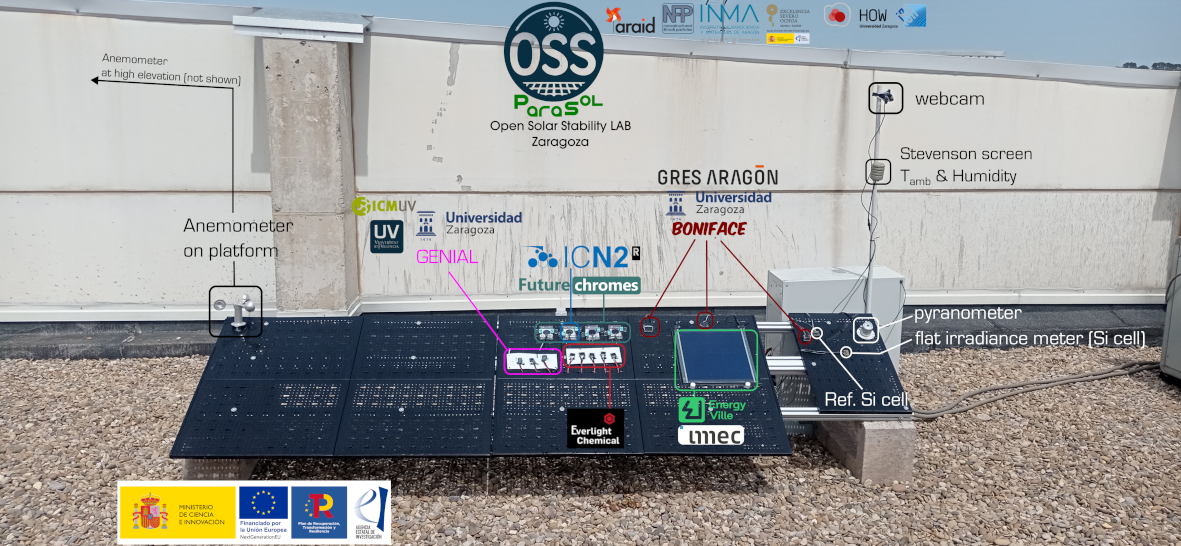 ParaSol — rooftop outdoor PV testing platform at INMA (CSIC – Universidad de Zaragoza). Each sample is identified by its partner’s logo placed next to it.
A few weeks ago I shared here that a perovskite solar cell on porcelain stoneware had crossed 430 days of continuous outdoor operation on our ParaSol platform — part of the BONIFACE project with Gres Aragón.
That cell is not alone up there.
ParaSol — the rooftop outdoor PV testing platform of the Open Solar Stability Lab at INMA (CSIC – Universidad de Zaragoza) — is currently hosting five experiments from five different organisations. Each sample sits next to its partner’s logo, so the picture identifies who is who.
1) Perovskite-on-porcelain-stoneware cells. BONIFACE project, with Gres Aragón (Grupo SAMCA). The 430+ day single cell and a module consisting of four single cells connected in series.
2) A perovskite module of more than 700 cm² from imec / EnergyVille.
3) Perovskite solar cells fabricated with green solvents. Project GENIAL (AEI Generación de Conocimiento), Universitat de València and Universidad de Zaragoza.
4) Our own perovskite cells encapsulated with Eversolar® UV-curable resins from Everlight Chemical.
5) A paraffin-based photothermochromic film developed at ICN2, with Futurechromes — a spin-off dedicated to advanced photochromic materials that are also being tested on the platform.
At the heart of it all sits Perovskino, our open-source MPPT tracker designed specifically for perovskite devices and the same hardware that quietly logged those 430 days of the BONIFACE cell. We are now also moving Perovskino through Universidad de Zaragoza’s spin-off route, to make it available beyond our own lab.
ParaSol also runs pyranometer, anemometer, humidity sensors, webcam and full data logging — everything needed to run a real-world degradation campaign rather than an indoor accelerated test.
We have five free slots in the cabinet right now. We can host anything from single cells up to modules with Voc up to 150 V. Typical campaigns last one year, or until we have enough data to extrapolate T80 — whichever comes first. At the end you get the full time-resolved dataset and a short report.
If your group, company or spin-off is curious to know whether your devices survive a real Iberian summer, drop me a line.
Acknowledgments
These collaborations are possible thanks to Ainhoa Bilbao (Gres Aragón), Arantxa Aguirre (imec / EnergyVille), Teresa S. Ripollés, Cristina Momblona and Noemí Farinós Navajas (project GENIAL, Universitat de València · Universidad de Zaragoza), Gordon Chao (Everlight Chemical), Claudio Roscini (Futurechromes) and the ICN2 team — and to my own group at the Nanostructured Films and Particles (NFP) group at INMA.
Get in touch
If you would like to test your devices on ParaSol, write to me at ejjuarezperez@unizar.es. We can host anything from single cells up to modules with Voc up to 150 V; campaigns typically run for one year or until enough data are accumulated to extrapolate T80, and at the end you receive the full time-resolved dataset and a short report.
This work is part of the BONIFACE project (CPP2022-009766), a public-private collaboration between the Institute of Nanoscience and Materials of Aragón (INMA, CSIC – University of Zaragoza) and Gres Aragón (SAMCA Group), funded by MCIN/AEI/10.13039/501100011033 and by the European Union — NextGenerationEU/PRTR.